
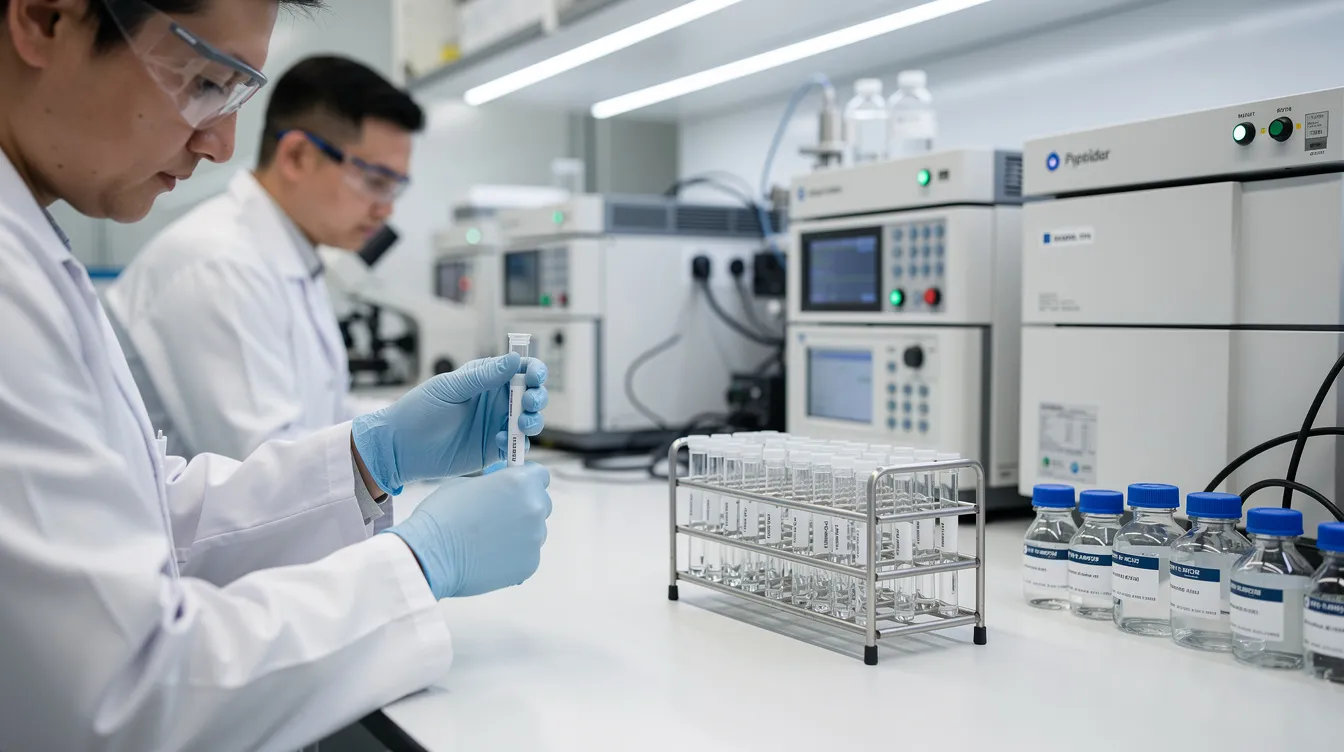
Peptide science is entering a period of rapid technological development. Advances in synthetic chemistry, structural biology, mass spectrometry, computational modelling, biotechnology and artificial intelligence are changing how researchers discover, design, manufacture and evaluate peptide molecules. What was once largely a field focused on naturally occurring signalling molecules and relatively simple peptide synthesis has developed into a sophisticated multidisciplinary area connecting molecular biology, pharmaceutical science, diagnostics, regenerative research and precision medicine.
The importance of this development extends beyond the discovery of individual peptides. Modern researchers increasingly view peptides as programmable biological molecules whose sequence, structure, stability, receptor interactions and delivery characteristics can potentially be engineered for specific scientific purposes. At the same time, the complexity of biological systems means that promising molecular designs still require rigorous analytical, preclinical and clinical evaluation before their significance to human health can be established.
From Natural Peptides to Engineered Molecules
Early peptide research was heavily concerned with identifying and understanding molecules already present in biological systems. Scientists isolated naturally occurring hormones, neuropeptides and other signalling molecules and investigated their structures and physiological functions.
Modern peptide science has expanded considerably beyond this approach.
Researchers can now deliberately modify peptide sequences to investigate how changes in molecular structure influence:
* Receptor binding
* Selectivity
* Stability
* Biological half-life
* Solubility
* Tissue distribution
* Protease resistance
* Cellular signalling
This transition from simply observing biological peptides to engineering molecular behaviour represents one of the most significant developments in the field.
Peptide Drug Discovery
Peptides occupy an interesting position between conventional small-molecule drugs and larger biological medicines.
Their molecular structures can provide highly specific interactions with biological targets, while their size and chemical characteristics can allow researchers to design molecules that engage targets differently from many conventional small molecules.
However, peptide medicines also present challenges involving:
* Enzymatic degradation
* Short circulation times
* Oral delivery
* Tissue penetration
* Manufacturing complexity
* Chemical stability
* Immunogenicity
Modern peptide drug discovery therefore increasingly involves molecular engineering rather than simply reproducing a naturally occurring sequence.
Long-Acting Peptides
One of the major objectives in pharmaceutical peptide development is extending the biological lifetime of peptide molecules.
Naturally occurring peptides can be rapidly degraded by enzymes or cleared from circulation. Researchers have developed multiple strategies to modify these properties.
These can include:
* Structural modification
* Lipid conjugation
* PEGylation
* Albumin-binding strategies
* Protease-resistant sequences
* Molecular cyclisation
* Formulation technologies
The objective is generally to produce a more predictable pharmacokinetic profile while retaining appropriate biological activity.
This has been particularly important in metabolic medicine, where several modern peptide therapeutics have been engineered to remain active considerably longer than their naturally occurring counterparts.
Oral Peptide Delivery
Oral delivery represents one of the most difficult challenges in peptide pharmaceutical development.
Many peptides are susceptible to degradation within the gastrointestinal tract, while their molecular size and physicochemical properties can make intestinal absorption difficult.
Researchers are therefore investigating strategies involving:
* Permeation enhancement
* Protective formulations
* Enteric delivery
* Nanotechnology
* Encapsulation
* Chemical modification
* Targeted delivery systems
The challenge is not merely getting a peptide into the digestive system. The molecule must survive sufficiently long, cross biological barriers and reach the circulation in an appropriate form and amount.
This makes oral peptide delivery an important area of pharmaceutical formulation research.
Multi-Receptor Peptide Design
Modern metabolic research has increasingly demonstrated the potential of targeting more than one receptor pathway simultaneously.
Instead of designing a molecule that interacts with only one receptor, researchers can investigate multi-receptor agonists capable of influencing several interconnected biological systems.
Examples of research directions include combinations involving:
* GLP-1
* GIP
* Glucagon
These pathways influence overlapping aspects of glucose metabolism, appetite, energy balance and lipid metabolism.
The scientific rationale is that coordinated receptor activation may produce biological effects that cannot be achieved as efficiently through a single pathway.
However, multi-receptor activity also introduces additional pharmacological complexity. Researchers must carefully determine receptor potency, selectivity, tissue distribution, dose-response relationships and potential adverse effects.
Peptide Conjugates
Another important development is the use of peptide conjugates.
Researchers can chemically attach peptides to other molecular components to modify their properties.
Conjugation strategies can influence:
* Circulation time
* Tissue targeting
* Cellular uptake
* Stability
* Receptor interaction
* Pharmacokinetics
A peptide may therefore serve not only as a biologically active molecule but also as a targeting or delivery component.
This is particularly interesting in areas where researchers need to direct molecules toward particular cells or tissues.
Targeted Peptide Delivery
Targeted delivery represents one of the broader ambitions of peptide biotechnology.
Researchers are investigating whether peptide sequences can recognise specific receptors or molecular features associated with particular tissues.
Potential applications include research involving:
* Cancer biology
* Cardiovascular disease
* Metabolic disorders
* Neurological disease
* Inflammation
* Regenerative medicine
The underlying principle is molecular recognition.
If a peptide can preferentially interact with a particular biological target, researchers may potentially use that interaction to improve localisation of a therapeutic or diagnostic payload.
However, achieving meaningful selectivity in a complex human organism is considerably more difficult than demonstrating receptor binding in a laboratory experiment.
Peptides and Precision Medicine
Precision medicine aims to move away from a purely population-wide model of treatment and toward approaches that account for biological differences between individuals.
These differences can involve:
* Genetics
* Metabolism
* Disease subtype
* Receptor expression
* Immune response
* Drug metabolism
* Environmental factors
Peptides could potentially contribute to precision medicine because their structures can be engineered to interact with specific molecular targets.
Future peptide therapies may therefore be designed not simply around a disease name but around particular molecular characteristics of a patient or disease subtype.
This remains an emerging field, but the underlying concept is becoming increasingly important across pharmaceutical research.
Artificial Intelligence and Peptide Discovery
Artificial intelligence is becoming increasingly relevant to peptide research.
Traditional peptide discovery can require the synthesis and experimental evaluation of large numbers of candidate molecules.
Computational approaches can potentially reduce this search space by predicting:
* Peptide structure
* Protein-peptide interactions
* Receptor binding
* Molecular properties
* Stability
* Biological activity
Machine-learning systems can analyse large biological datasets and identify patterns that may be difficult to detect through conventional approaches.
This does not mean that artificial intelligence can replace laboratory research.
Instead, AI can function as a hypothesis-generation and prioritisation tool, helping researchers decide which candidates are most worthy of experimental testing.
Computational Peptide Design
Computational methods are increasingly being used to design peptide sequences with particular characteristics.
Researchers can model relationships between:
Sequence → structure → interaction → function
The ultimate objective is to move from trial-and-error discovery toward more rational molecular design.
Structural databases, protein modelling, molecular dynamics and machine learning can all contribute to this process.
The most effective future systems will likely combine computational prediction with automated synthesis and experimental validation.
Peptidomics and the Discovery of New Biology
Peptidomics provides another major avenue for future research.
Rather than studying individual peptides in isolation, researchers can analyse complex populations of endogenous peptides within biological samples.
Advanced mass spectrometry can detect large numbers of peptide species and investigate how their abundance changes under different physiological or pathological conditions.
This can help researchers identify:
* Previously unknown peptides
* Biomarkers
* Processing products
* Disease-associated signalling molecules
* Changes in peptide networks
The continued development of high-resolution mass spectrometry and computational analysis is likely to expand this field significantly.
Peptides and Biomarker Discovery
Biomarkers are measurable biological characteristics that can provide information about physiological or pathological processes.
Peptides can potentially serve as biomarkers because their concentrations or molecular forms may change in association with disease or physiological states.
Researchers are investigating peptide biomarkers in areas including:
* Cancer
* Cardiovascular disease
* Metabolic disease
* Neurological disorders
* Inflammatory conditions
However, identifying an association is only the beginning.
A clinically useful biomarker must demonstrate appropriate accuracy, reproducibility, sensitivity, specificity and practical value within a defined clinical context.
Peptide-Based Diagnostics
Peptide science also intersects with diagnostic biotechnology.
Researchers can design peptides capable of recognising particular proteins, antibodies, receptors or other molecular targets.
These molecules may potentially contribute to:
* Biosensors
* Diagnostic assays
* Imaging systems
* Molecular detection platforms
* Research tools
The advantage of peptides in some applications is their ability to be chemically synthesised and modified with considerable precision.
This allows researchers to incorporate peptides into increasingly sophisticated diagnostic architectures.
Peptides in Oncology Research
Cancer research is another area in which peptide biotechnology is being investigated extensively.
Researchers are exploring peptides for:
* Target recognition
* Drug delivery
* Tumour imaging
* Cell penetration
* Immune modulation
* Diagnostic development
One potential advantage of targeted peptide systems is the ability to exploit molecular differences between tumour cells and healthy tissues.
Nevertheless, cancer is biologically heterogeneous, and successful targeting requires considerably more than demonstrating that a peptide binds to a cancer-associated receptor.
Peptides and Regenerative Research
Peptide biology also intersects with regenerative medicine.
Researchers investigate signalling molecules that influence:
* Cell migration
* Cell proliferation
* Differentiation
* Extracellular-matrix formation
* Tissue repair
* Angiogenesis
Peptides may therefore serve as biological signals or molecular tools within regenerative research.
However, regenerative biology remains highly complex. Tissue repair depends on coordinated interactions among cells, extracellular matrix, vascular systems, immune responses and mechanical environments.
A single peptide cannot automatically reproduce the complexity of an entire regenerative process.
Peptides and Neuroscience
The nervous system contains numerous peptide signalling molecules.
Neuropeptides can influence:
* Pain
* Appetite
* Stress
* Sleep
* Autonomic activity
* Neuroendocrine regulation
Researchers are investigating peptide systems in relation to neurological and psychiatric disorders as well as fundamental neuroscience.
One challenge is delivery.
The blood-brain barrier creates substantial obstacles for many therapeutic molecules, meaning that researchers must carefully investigate whether a peptide can reach its intended neural target at an appropriate concentration.
Peptide Stability Will Remain a Central Challenge
Despite rapid advances, peptide stability remains one of the fundamental problems in peptide science.
Researchers must continue to address:
* Proteolytic degradation
* Chemical instability
* Aggregation
* Poor membrane permeability
* Limited oral bioavailability
* Storage stability
Future peptide design will increasingly integrate these considerations from the earliest stages of molecular development.
Rather than designing a peptide first and attempting to solve stability problems afterward, researchers can incorporate stability and delivery characteristics into the initial molecular design process.
Advanced Manufacturing
As peptide therapeutics become more sophisticated, manufacturing technologies must evolve alongside them.
Modern peptide manufacturing can involve:
* Automated synthesis
* Continuous processing
* Improved coupling chemistry
* Advanced purification
* High-resolution analytical testing
* Process monitoring
* Stability programmes
Manufacturing consistency is particularly important when a peptide progresses from laboratory research into pharmaceutical development.
The molecule must not only work scientifically; it must also be produced reproducibly at the required quality and scale.
Sustainable Peptide Manufacturing
Peptide synthesis can consume considerable quantities of solvents and chemical reagents.
This has created growing interest in more sustainable manufacturing approaches.
Researchers are investigating:
* Reduced-solvent processes
* Solvent recycling
* More efficient coupling chemistry
* Alternative reaction systems
* Continuous manufacturing
* Improved purification efficiency
Sustainability will become increasingly important as peptide production expands.
The challenge will be achieving lower environmental impact without compromising molecular quality or manufacturing reliability.
Regulatory Science Will Become More Important
Scientific innovation must ultimately operate within appropriate regulatory frameworks.
As new peptide technologies emerge, regulators need methods for evaluating:
* Molecular identity
* Purity
* Impurities
* Stability
* Manufacturing consistency
* Pharmacokinetics
* Pharmacodynamics
* Safety
* Immunogenicity
* Clinical efficacy
This is particularly important because increasingly complex peptide molecules can present analytical challenges that differ from conventional small-molecule drugs.
Regulatory science therefore evolves alongside pharmaceutical innovation.
The Difference Between Research and Approved Medicine
The expanding peptide field makes one distinction especially important:
Scientific possibility is not the same as clinical approval.
A peptide can be:
* Identified in nature
* Synthesised in a laboratory
* Studied in cells
* Tested in animals
* Investigated in human clinical trials
* Approved as a medicine
These represent very different stages of scientific development.
A compound that has demonstrated biological activity in a laboratory should therefore not automatically be presented as a proven treatment.
The transition from molecular discovery to approved medicine requires substantial evidence.
The Role of Human Clinical Research
Ultimately, the relevance of peptide biotechnology to human health must be demonstrated through appropriately designed studies.
Clinical research can evaluate:
* Safety
* Tolerability
* Pharmacokinetics
* Pharmacodynamics
* Dose response
* Efficacy
* Adverse effects
* Long-term outcomes
Early laboratory findings can help generate hypotheses, but human clinical research is essential for determining whether an intervention actually provides meaningful benefit in people.
What the Next Generation of Peptide Science May Look Like
The future is likely to be characterised by increasing convergence between technologies.
A future peptide discovery platform could potentially combine:
AI-assisted sequence design
with
automated peptide synthesis
followed by
high-throughput purification
and
mass-spectrometric characterization
before moving into
automated biological screening.
This integrated workflow could dramatically accelerate the process of identifying and evaluating candidate molecules.
Researchers could then use experimental results to train improved computational models, creating a continuous cycle between prediction and laboratory validation.
Peptides and the Broader Biotechnology Revolution
Peptide science is not developing in isolation.
It is part of a broader biotechnology transformation involving:
* Genomics
* Proteomics
* Transcriptomics
* Metabolomics
* Gene editing
* Cell therapy
* Nanotechnology
* Artificial intelligence
* Precision medicine
The convergence of these technologies could provide researchers with unprecedented insight into biological systems.
Peptides may serve as both subjects of investigation and tools for manipulating biological pathways.
The Importance of Scientific Restraint
The faster peptide science advances, the more important responsible scientific communication becomes.
A compelling mechanism is not proof of clinical efficacy.
A successful animal experiment is not proof of human benefit.
A high-purity laboratory sample is not automatically a pharmaceutical.
A biomarker change is not necessarily rejuvenation.
And a promising peptide candidate is not automatically an approved medicine.
Maintaining these distinctions protects scientific integrity and allows genuinely meaningful discoveries to stand out from exaggerated claims.
The Future of Human Health and Peptide Biotechnology
The long-term significance of peptide science may ultimately lie in its versatility.
Peptides can function as signalling molecules, therapeutic agents, targeting ligands, diagnostic components and experimental tools. Their chemistry allows researchers to modify their properties with increasing precision, while advances in biotechnology are making discovery and characterization faster and more sophisticated.
Future applications could emerge across metabolic medicine, oncology, endocrinology, dermatology, neuroscience, regenerative biology and diagnostics.
Not every promising molecule will succeed. Many will fail during development, and some will demonstrate biological effects that are ultimately too weak, too unpredictable or too difficult to deliver safely.
That is a normal part of scientific progress.
Conclusion
The future of peptide science is being shaped by the convergence of molecular engineering, analytical chemistry, biotechnology, computational biology and pharmaceutical research. Researchers are no longer limited to discovering naturally occurring peptides; they can increasingly design and modify molecules with specific structural and functional objectives.
Long-acting peptides, multi-receptor molecules, targeted delivery systems, peptide conjugates, computational discovery, AI-assisted design and advanced analytical technologies are all expanding the possibilities of the field. At the same time, peptide science continues to face fundamental challenges involving stability, delivery, manufacturing, characterization and clinical translation.
The most important developments will therefore not simply be the discovery of new peptides. They will be the development of reliable methods for determining which molecules work, why they work, for whom they work, how safely they can be delivered and whether their benefits can be demonstrated in rigorous human research.
For Elite Peptides, understanding this distinction is central to responsible scientific communication. The future of peptide biotechnology is exceptionally promising, but its value will ultimately be determined not by the strength of the claims surrounding it, but by the quality and reproducibility of the evidence supporting those claims.