Peptide research combines organic chemistry, molecular biology, analytical chemistry, pharmacology and biotechnology. Before a peptide can be meaningfully studied, researchers need to establish what molecule they are working with, how it was produced, how it was purified and whether its measured characteristics correspond with the intended structure.
The laboratory process therefore extends far beyond simply synthesising an amino-acid sequence. Modern peptide research typically involves a progression from design and synthesis through purification, analytical characterization, stability assessment and, where appropriate, biological investigation. Solid-phase peptide synthesis, chromatography and mass spectrometry are among the core technologies supporting this workflow.
From Molecular Design to Laboratory Material
Peptide research generally begins with a defined scientific objective.
Researchers may want to:
* Investigate a naturally occurring signalling molecule
* Study receptor interactions
* Examine a biological mechanism
* Develop a molecular probe
* Investigate a potential therapeutic candidate
* Understand structure-function relationships
* Produce material for analytical or biochemical experiments
The desired amino-acid sequence is established before synthesis or biological production begins.
Researchers may also specify structural features such as:
* Sequence
* Chain length
* Terminal groups
* Disulfide bonds
* Cyclisation
* Chemical modifications
* Isotopic labelling
* Conjugated molecules
These specifications determine how the peptide must subsequently be produced and analysed.
Peptide Synthesis
There are several approaches to producing peptides, including biological expression and chemical synthesis.
For many laboratory and pharmaceutical applications, solid-phase peptide synthesis (SPPS) remains one of the most important chemical production technologies.
SPPS was developed from the pioneering work of Robert Bruce Merrifield and fundamentally changed the practical synthesis of peptides by allowing growing peptide chains to remain attached to a solid support during sequential assembly.
The basic concept is:
Solid support → amino-acid coupling → deprotection → repeated chain extension → cleavage → purification
This approach allows researchers to construct specific sequences systematically.
Solid-Phase Peptide Synthesis
During SPPS, the first amino acid is attached to a solid resin.
Additional amino acids are then added sequentially.
A simplified cycle involves:
1. Protecting-group removal
2. Amino-acid coupling
3. Washing
4. Repetition of the cycle
The process continues until the desired sequence has been assembled.
Protecting groups are essential because amino acids contain multiple chemically reactive groups. Selective protection allows the intended peptide bond to form without unwanted reactions elsewhere in the molecule.
Modern SPPS protocols incorporate numerous improvements in coupling chemistry, protecting groups, resins and automation.
Why Synthesis Is Not Perfect
Even carefully controlled peptide synthesis can generate unintended products.
Potential impurities include:
* Deletion sequences
* Incomplete coupling products
* Incompletely deprotected molecules
* Oxidised species
* Modified side products
* Stereochemical impurities
* Truncated peptides
* Aggregation-related products
This is one reason synthesis and purification are separate stages.
The objective is not simply to construct a peptide but to isolate the intended molecular species from the other materials generated during production.
Cleavage From the Resin
Once the peptide sequence has been assembled, it must be released from the solid support.
The cleavage process also removes protecting groups that are no longer required.
At this stage, the resulting material is generally considered a crude peptide mixture rather than a fully characterised final product.
The crude mixture may contain:
* Desired peptide
* Incomplete sequences
* Side products
* Residual reagents
* Protecting-group-related compounds
* Other process impurities
Further purification is therefore normally required before detailed characterization.
Peptide Purification
Purification separates the intended peptide from unwanted components.
One of the most widely used approaches is high-performance liquid chromatography (HPLC).
HPLC can separate peptide molecules according to differences in their chemical and physical properties.
Common chromatographic approaches include:
* Reversed-phase HPLC
* Ion-exchange chromatography
* Size-exclusion chromatography
* Other specialised separation techniques
Reversed-phase HPLC is particularly important in peptide purification because it can separate molecules with subtle differences in hydrophobicity.
Reversed-Phase HPLC
In reversed-phase HPLC, peptides interact with a hydrophobic stationary phase while being carried through the column by a mobile phase.
Changes in solvent composition alter the interaction between peptide molecules and the stationary phase.
Different molecular species therefore elute at different times.
The resulting chromatogram contains peaks representing separated components.
Researchers can use these profiles to investigate:
* Relative purity
* Separation efficiency
* Impurity profiles
* Retention characteristics
* Reproducibility
However, a chromatographic peak alone does not establish molecular identity.
That requires complementary analytical evidence.
Why Purification and Characterization Are Different
A purified sample is not necessarily a completely characterised sample.
Purification answers a question such as:
How effectively have unwanted components been separated from the target material?
Characterization asks:
Is the material actually the intended molecule, and what are its measurable properties?
These are related but different analytical questions.
Modern peptide characterization commonly combines chromatographic and mass-spectrometric methods rather than relying on a single test.
Mass Spectrometry
Mass spectrometry (MS) is one of the most important analytical technologies in peptide research.
It measures ions according to their mass-to-charge ratio.
Researchers can use mass spectrometry to investigate:
* Molecular mass
* Molecular identity
* Sequence-related information
* Chemical modifications
* Impurity species
* Degradation products
Soft-ionisation techniques such as electrospray ionisation and MALDI have become particularly valuable for peptide analysis.
LC-MS
Combining liquid chromatography with mass spectrometry creates a powerful analytical platform.
LC separates components.
MS then provides molecular-mass information about the separated components.
This combination allows researchers to determine not only whether multiple components exist but also to investigate the molecular characteristics of those components.
For complex peptide mixtures, this can provide considerably more information than chromatography alone.
Tandem Mass Spectrometry
Tandem mass spectrometry, or MS/MS, provides additional structural information.
A peptide ion can be fragmented into smaller pieces, and the resulting fragments can be analysed to help establish the amino-acid sequence.
This is particularly valuable when researchers need to determine whether the synthesised material corresponds to the intended sequence.
Modern analytical guidance emphasises the complementary use of chromatography and mass spectrometry when establishing peptide identity and purity.
Identity vs Purity
These two terms are frequently confused.
Identity
Identity asks:
Is this actually the intended peptide?
Mass spectrometry can provide important evidence by comparing measured molecular mass with the expected molecular mass, while MS/MS can provide sequence-related evidence.
Purity
Purity asks:
How much of the analysed material corresponds to the desired peptide relative to detected impurities?
Chromatographic methods such as HPLC can provide an estimate of relative purity.
A material can therefore have a high apparent chromatographic purity while still requiring additional testing to establish identity and other quality attributes.
Why One Analytical Method Is Not Always Enough
No analytical technique answers every question.
HPLC is highly useful for separation and relative purity assessment, but it does not necessarily identify every chromatographic component.
Mass spectrometry provides molecular-mass information but may not distinguish all structural or stereochemical possibilities.
This is why researchers use orthogonal analytical methods.
The principle is simple:
Different analytical methods should provide independent information about different properties of the same material.
Scientific guidance on synthetic peptide characterization recommends combining complementary approaches rather than relying on a single measurement.
Sequence Confirmation
Confirming molecular mass alone does not always prove the complete covalent structure.
Two molecular species can potentially share similar or identical mass characteristics while differing in structural details.
Sequence confirmation can therefore provide additional confidence.
Techniques may include:
* Tandem mass spectrometry
* Peptide mapping
* Sequencing approaches
* Nuclear magnetic resonance in appropriate applications
* Other structural methods
The appropriate analytical strategy depends on the peptide and the scientific question.
Peptide Content and Counterions
Another important consideration is the distinction between nominal sample mass and actual peptide content.
A peptide preparation may contain:
* Water
* Counterions
* Residual solvents
* Other non-peptide components
Consequently, weighing a dried sample does not necessarily tell researchers the exact amount of peptide present.
Analytical approaches such as amino-acid analysis can provide additional information about peptide content in appropriate applications.
This is particularly important when quantitative experiments require accurately characterised material.
Stability Testing
A peptide that is correctly synthesised and purified can still change over time.
Researchers therefore investigate stability under relevant conditions.
Potential degradation pathways include:
* Oxidation
* Deamidation
* Hydrolysis
* Disulfide-bond changes
* Aggregation
* Other chemical modifications
Peptide stability can be influenced by:
* Temperature
* pH
* Moisture
* Oxygen
* Light
* Concentration
* Solvent
* Molecular sequence
Analytical methods can then be used to monitor whether new degradation products appear over time.
Lyophilization
Many peptide preparations are stored in lyophilised, or freeze-dried, form.
Lyophilization removes water under controlled conditions and can provide a stable solid preparation for storage.
However, lyophilization does not eliminate all stability considerations.
Researchers still need to consider:
* Residual moisture
* Container closure
* Temperature
* Reconstitution conditions
* Chemical stability
* Storage duration
The appropriate storage strategy depends on the specific peptide and its formulation.
Reconstitution and Experimental Preparation
When a lyophilised peptide is prepared for laboratory work, the researcher must consider the intended experimental system.
Relevant variables can include:
* Solvent compatibility
* Concentration
* pH
* Peptide solubility
* Aggregation
* Adsorption to surfaces
* Stability after reconstitution
Different peptide sequences can behave very differently in solution.
A highly hydrophobic peptide, for example, may present substantially different formulation challenges from a highly charged peptide.
Peptide Aggregation
Aggregation is another important area of peptide research.
Individual peptide molecules can sometimes associate into larger assemblies.
Aggregation may influence:
* Solubility
* Stability
* Biological activity
* Analytical measurements
* Experimental reproducibility
Researchers therefore need to distinguish between the intended molecular species and unintended higher-order assemblies.
Depending on the scientific question, techniques such as chromatography, spectroscopy or other biophysical approaches can be used to investigate aggregation.
Quality Control in Peptide Research
A robust peptide quality-control programme can involve multiple attributes.
Researchers may evaluate:
Identity
Is the intended peptide present?
Purity
What impurities are detectable?
Content
How much actual peptide is present?
Structure
Does the molecular structure correspond to the intended compound?
Stability
Does the material remain chemically intact?
Physical characteristics
Does the peptide maintain appropriate properties under the intended conditions?
Reference standards can also play an important role in establishing identity, purity and strength for peptide materials.
From Chemical Characterization to Biological Testing
Once a peptide has been adequately characterised, researchers may investigate its biological behaviour.
Depending on the research question, this could involve:
* Receptor-binding studies
* Enzyme assays
* Cell-based experiments
* Tissue models
* Pharmacological studies
* Animal research
* Eventually, appropriately regulated human studies
These stages answer different scientific questions.
A peptide demonstrating chemical identity does not automatically demonstrate biological activity.
Likewise, biological activity in an experimental model does not automatically establish clinical efficacy.
Reproducibility Matters
A major principle of scientific research is reproducibility.
A result becomes considerably more informative when independent experiments can reproduce the observation.
For peptide research, reproducibility can depend on:
* Peptide identity
* Purity
* Concentration
* Formulation
* Storage
* Experimental conditions
* Assay methodology
* Biological model
Poorly characterised material can therefore introduce uncertainty into downstream experiments.
Documentation and Traceability
High-quality laboratory research depends on accurate documentation.
Researchers may record:
* Peptide name
* Sequence
* Batch number
* Synthesis information
* Analytical results
* Purification information
* Storage conditions
* Preparation date
* Concentration
* Experimental conditions
Traceability makes it possible to determine which material was used in a particular experiment and whether changes in results could be associated with differences between batches.
From Research Material to Pharmaceutical Development
The laboratory characterization process becomes even more demanding when a peptide advances toward pharmaceutical development.
Pharmaceutical peptide development involves increasingly comprehensive evaluation of:
* Identity
* Purity
* Potency
* Impurities
* Degradation products
* Manufacturing consistency
* Stability
* Safety
* Clinical performance
Regulatory-quality peptide characterization can involve multiple complementary analytical technologies, including chromatography, mass spectrometry and other structural methods.
This illustrates an important principle:
Research-grade characterization and pharmaceutical quality systems are related, but they are not automatically equivalent.
The Role of Automation
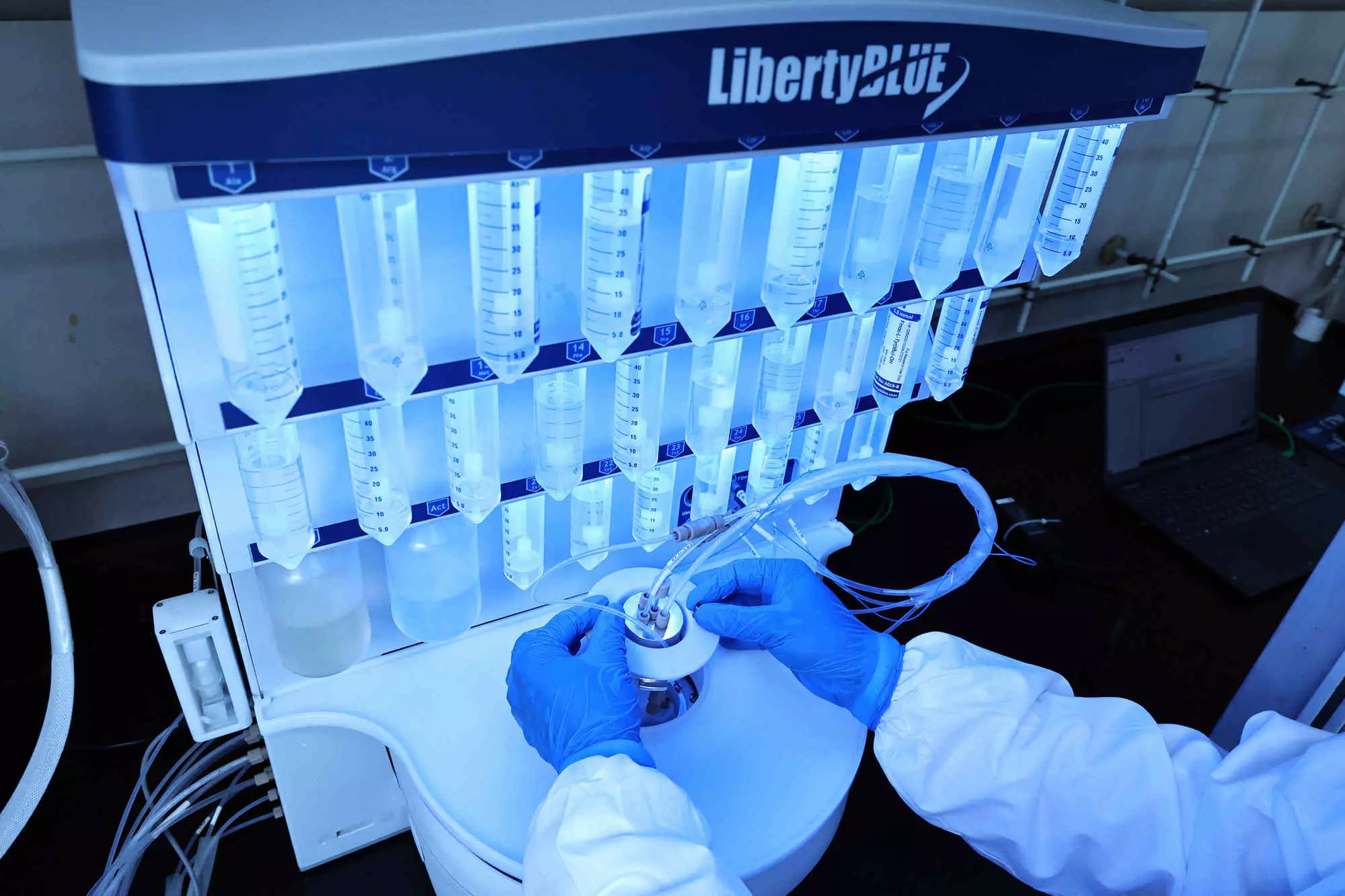
Modern peptide laboratories increasingly use automation to improve consistency and throughput.
Automated synthesis platforms can perform repeated coupling and deprotection cycles with controlled timing and reagent delivery.
High-throughput approaches allow researchers to produce and screen larger numbers of peptide sequences.
Automation can therefore accelerate:
* Sequence libraries
* Structure-activity studies
* Drug discovery
* Analytical workflows
* Screening programmes
However, automation does not remove the need for analytical verification.
A machine can reproduce a synthesis protocol consistently while still producing an incorrect or impure molecule if the underlying chemistry or process is flawed.
Green Peptide Chemistry
Peptide synthesis can consume substantial quantities of solvents and reagents.
Consequently, modern research increasingly examines ways to make peptide production more efficient and environmentally sustainable.
Areas of investigation include:
* Solvent reduction
* Improved coupling efficiency
* Recycling
* Alternative solvents
* More efficient purification
* Process optimisation
* Continuous manufacturing
Recent peptide-synthesis research specifically highlights the challenge of maintaining product quality while reducing environmental impact.
Why the Laboratory Workflow Matters
The peptide research workflow can be summarised as:
Design
↓
Synthesis or biological production
↓
Cleavage / recovery
↓
Purification
↓
Identity confirmation
↓
Purity assessment
↓
Structural characterization
↓
Stability evaluation
↓
Biological investigation
↓
Documentation and reproducibility
Each stage provides information that supports the next.
Skipping analytical characterization can create uncertainty throughout the downstream research process.
Conclusion
Modern peptide research is a multidisciplinary process that extends far beyond peptide synthesis.
Researchers must establish the intended molecular structure, produce the material, remove unwanted components and then demonstrate through complementary analytical methods that the resulting material corresponds to the intended peptide.
Solid-phase peptide synthesis provides a powerful method for constructing defined peptide sequences, while HPLC supports purification and separation and mass spectrometry provides critical information about molecular identity and structure.
The most reliable peptide characterization therefore comes from combining multiple analytical techniques rather than relying on a single purity percentage or analytical result.
This rigorous laboratory workflow provides the scientific foundation for the next stage of our discussion: how peptide purity, quality and laboratory standards are evaluated in greater detail.